
Images cropped for better viewing.
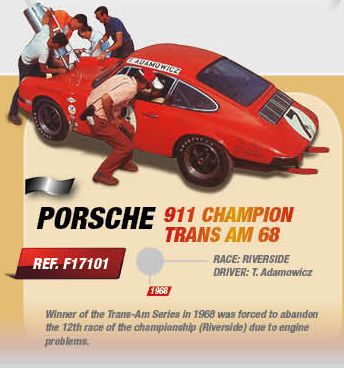
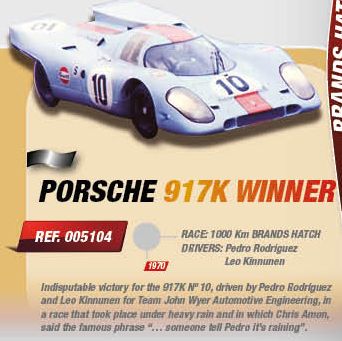
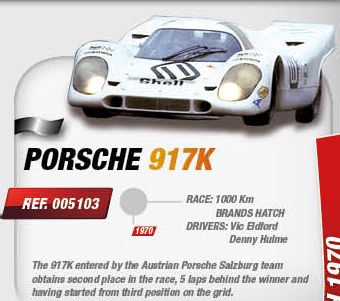
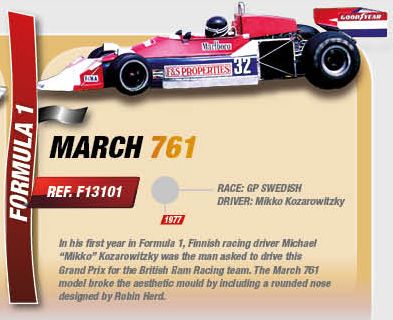
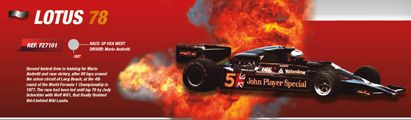

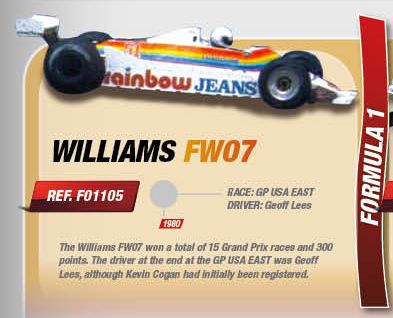
The full inside pages.


NINCO Porsche 356 – Average 9.596s
Wood: 8.986s / Plastic 10.205s / Mass 65g / Magnetic Downforce 3g
The NINCO Porsche 356 I tested is part of NINCO's classic line. It is powered by NINCO's venerable NC1 motor and while it isn't the fastest car in this review, it is one of the better handling cars. The wheels needed to be glued to their axles prior to testing but ran fairly true for plastic wheels. Owing to the length of the straights on my test tracks the lack of grunt from its NC1 held this car back.
SCX Alpine A110 – Average 9.582s
Wood: 8.973s / Plastic: 10.191s / Mass 67g / Magnetic Downforce 17g
SCX produces a plethora of rally cars. The Alpine A110 is a fairly recent example powered by their unique RX41B motor. This car also has working lights. The wheels on my test car were firmly attached to the axles and reasonable true for plastic wheels. This car also ran out of steam on the long straights of my test tracks reaching top speed after about 2m. If I were looking for more speed the first change I would make would be to replace the 9z stock pinon with a 10z as the stock power plant seems to have plenty of grunt. The RX motors only seem to get faster as they wear in.
Scalextric Austin Mini – Average 9.580s

The Mini suffered the opposite problem of the previous two cars in that it is way overpowered for such a tiny model. This model too has working lights. Scalextric most likely chose the slim can FF050 by reason of packaging considerations. Masive power aside, the wheels on my test car are firmly attached and reasonably round. I had to drive this car with care through the corners but could really wind it out on the straights. This car would benefit from a less powerful motor.
SCX Fiat Abarth 124 – Average 9.420s
Wood: 8.741s / Plastic: 10.099s / Mass: 73g / Magnetic Downforce: 10g
Another reasonably powered SCX rally car with working lights. Again, this model was blessed with round wheels and straight axles. The FIAT is another good handling car in the corners that was lacking in top speed. Increasing the pinion tooth count to 10 would help the lap times drop.
NINCO Renault Clio – Average 9.313s
Wood: 8.863s / Plastic: 9.762s / Mass: 67g / Magnetic Downforce: 3g
It seems to me that NINCO used to put the NC1 in just about every car they made. The Clio is no exception. The wheels on this example needed a drop of glue to keep them on their axles. Other than that this car was good to go. A bit more motor or slightly taller gear might have moved this car up in the standings. Still an easy handling easy to drive car.
Fly Porsche 911 – Average 9.245s
Fly's model of this ubiquitous rally car is true to the prototype's motor layout in that it is placed behind the rear axle. Out of the box with the traction magnet removed the car is undriveable. Only with the addition of lead up front was this car tamed. Otherwise its nose was happy to bounce right out of the slot under acceleration.
SCX Lancia Stratos – Average 9.187s
Yet another SCX rally car powered by the RX alphabet soup of motors: this time the RX4. The reasonably true wheels on my example were loose on the axle but this problem was easily fixed with a drop of glue. The Stratos is a small car with a short wheelbase but since it was not overpowered it was an easy driver. Another case where less is more – though I would bump up the pinion tooth count by one if I wanted it to go faster. The nose on this car could use some lowering as well.
Fly Lancia 037 – Average 8.885s
Fly had done for their rally cars what they had also done for classic LeMans prototypes: offering detailed models in a sidewinder configuration with reasonable FC130 black stripe power. My test car had a spur gear that spun on the axle. I decided to forgo attempting to repair the stock gear and swapped out the defective components for Slot Car Corner Canada bushings and a Slot.it gear and axle. The stock wheels were retained. The Lancia 037 is a good looking good handling car that will only get faster with mild tuning.
Fly Lancia Betamontecarlo – Average 8.696s
While this Fly car is also a sidewinder, its sidewinder motor pod chassis has more in common with the Fly Classics line than the one piece chassis of the Lancia 037. What this car did have in common with the 037 was a spur gear that spun on the axle. A similar swap to SCC bushings, Slot.it axle, and red Slot.it 36z spur gear made everything right. A fun car to drive once made to run right.
Scalextric Ford Escort – Average 8.674s
Scalextric brings us another rally car with functioning lights and slim can power. Unfortunately, the crown gear was not up to task in my test car and eventually failed by having a couple sections of the toothed part break away. This is the first time I've experienced a failure like this. While this car ran, it ran great if a tad overpowered.
Fly Renault 5 – Average 8.544s
The Renault 5 is another Fly sidewinder with black stripe power. It is also another car with a spur gear that spun on the axle – and a problem that was fixed by replacing the defective components with the good stuff from SCC and Slot.it. The stock wheels were retained. Once tuned it was a smooth runner and easy to drive at the limit.
Spirit BMW 1602 – Average 8.244s
I have to admit that I have a love-hate relationship with Spirit cars. I love some of Spirit's design ideas and the subjects they choose to model. I hate their choice of materials and components. A problem I consistently have with Spirit cars is that any setscrews installed from the factory tend to strip at the first twist of my hex driver. Consequently, the first thing I do when race tuning a Spirit car is replace all their setscrews with Slot.it parts. When I tried to remove the setscrews used to set the front axle height on this car the axle carrier broke right off. I ended up hot-gluing a brass tube onto the BMW's chassis to carry the front axle. Of course, the crown gear's setscrew was stripped. Once the factory's mistakes were fixed, the Spirit BMW turned out to be a barn burner. It was the fastest of all the cars on wood or plastic. The open can FK180 used in this car generates 36g of downforce and sits in an adjustable motor pod. The driver's side mirror was the first casualty of my spirited driving – not something that will be needed given the outright speed of this car once sorted vs. the competition.
Thank-you to Mini Grid and Race Haven Hobbies for the use of the test facilities and to Art Tschinkel for being able to provide me with his superb DArts tires to suit each of the models in this test.
Van LaPointe

 As any of you who have seen my slot car collection or visited my Rennsport Reunion III Gallery can tell you: I like my Porsches. We've had the good fortune to have many
  models of these great German cars released as slot cars. The problem with many of these Porsche models is a problem that's common across the whole range of slot car manufacturers: wobbly eccentric wheels and bent axles.
 If you're looking to upgrade the Porsches in your colletion then BWA Wheels are one likely source for replacement parts. These wheels come in different sizes and allow the slot car racing hobbyist to replace wheels from the narrowest ones used on vintage cars, to the monster rubber used on racing prototypes. What we haven't always had access to are the inserts necessary to finish off these great aftermarket wheels - until now.
 BWA has augmented their range of inserts which has up until now included vintage Porsche steel wheel style inserts as well as 5 spoke alloy wheel style inserts with the Fuchs alloy inserts first used on the Porsche 911 model both for street and track use. All of
  these inserts fit the 32002, 32004, and 32006 wheels from BWA. With a bit of sanding and paint they look great and really finish off the look of any Porsche model slot cars as well as enhance their performance. The steel type wheels are great for Porsche 356, 904, 906, 550 spyder and other vintage machinery.
  The Fuchs inserts look great on the 911 series cars and have also been used on 904 and 356 series cars. The five spoke alloy inserts look great on 908s, 917s and the Carrera 911 RSR pictured. Between these three inserts just about the whole model range of older cars are covered. The BWA wheels and inserts are available from better slot car parts retailers as well as from BWA directly.


 The tires and wheels on my version were concentric, and everything you could want in your ready to run car. The Oz Racing type of wheels on this vintage car is odd and I'd prefer the Fuchs wheels, lace BBS style, or Mini-lights wheels on the regular production 911/934's.





 Formula 1
 slot car


